Showing posts with label San Francisco History. Show all posts

7.02.2011

Golden Gate?

Golden Gate I  6.14.11

If you have been around San Francisco for any amount of time, you will definitely see a reference to the Golden Gate, the most obvious being the Golden Gate Bridge.  You will also hear the term used in almost any song talking about San Francisco.  We now have restaurants, apartment houses, businesses, hobby clubs, etc. using the name to show themselves as local and loyal to the Bay Area.

The term Golden Gate refers to the entrance of the bay between Marin and San Francisco which is now connected by the bridge.  Before the bridge, the name was still used for that specific area.

Why Golden Gate?  Many think it is a term relating to the California Gold Rush.  It makes sense, but it is incorrect.  It was actually named by John C. Fremont after he first viewed the entrance to the bay.  It reminded him of the sea entrance to to Byzantium, now called Istanbul.  The entrance to that historic harbor is named Chryoceras (Greek for Golden Horn).  The geographical characteristics, as well as the possible commercial uses of this area, are what led Fremont to name this area of the bay Chrysopylae, or Golden Gate.

Cheers!

Mike

Reference:  San Francisco Memoirs 1835-1851: Eyewitness accounts of the birth of a city, by Malcolm E. Barker

bay 6.14.11

6.24.2011

The Hanlon House, San Francisco


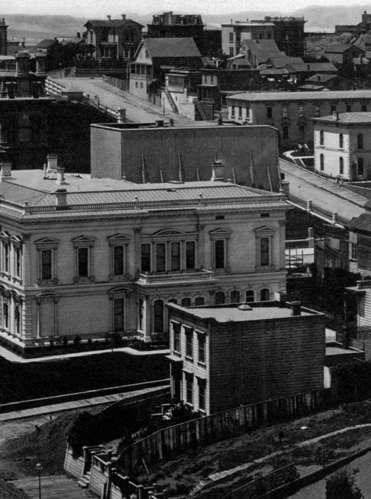
If you find yourself walking around the Russian Hill/Nob Hill neighborhood on Jackson Street, take a couple of moments to walk by the Hanlon House at 1659 Jackson Street.  It was built in 1881 and moved to its current location after the 1906 San Francisco Earthquake and Fire.   

It is fascinating to reflect on all the life and conversations that have occurred in this residence.  The 130 year old home began its life during the Victorian Age, when women and men dressed elaborately and kept their parlors over decorated.  It was an age of showy excess, and this house looks like it belonged to that era.  Families continued to live in the house during the times of World War 1 & 2, McCarthyism,  poodle skirts, first moon walk, the Cold War, the Civil Rights Movement, the Summer of Love, and the AIDS pandemic.  Most recently, this house witnessed the advent of accessible technology flood it's rooms.  It was built around the time that the phone was invented, and now cell phones, computers, laptops, and televisions are used on the premises.

From the looks of this residence, it is not going anywhere anytime soon.  Maybe in the future it will be cars, and not just planes, that the grand old lady will see flying above it's rooftop and chimneys. 

Cheers!

Mike

IMAG0343

6.04.2011

Leland Stanford (One of the "Big Four")

Leland Stanford, one of San Francisco's infamous "Big Four," did not come from remarkable origins. He had seven other siblings, and was the son of an innkeeper. After a short time in the law profession, Leland came to California in order to work with his brothers to start up a grocery in Sacramento. His brothers moved on to other pursuits, but Leland stayed faithful to the small grocery store.

Opportunity Knocks!

One of his customers was struggling to keep his gold mine open and pay the grocery bill, so he paid Leland in shares of his mine. For whatever reason, Leland decided to accept these shares as payment for the bill. One must wonder if he was motivated by charity or greed. It turns out that this was quite possibly one of the two best business decisions Leland ever made in his life. The gold mine was successful, and it eventually made him half a million dollars. This was not a bad return for a few groceries.

Opportunity Knocks!

After amassing a tidy sum of money that cemented his place as a wealthy businessman in the Bay Area, he attended a presentation by a railroad engineer named Theodore Judah.   He was a convincing orator, and Judah left that presentation with many commitments to buy shares in his idea to build a railroad through the Sierra Foot Hills to the mines. It was a successful business venture, and this was the beginning of the creation of Leland's fortune. He became known as one of the Big Four in San Francisco, and created an empire based on the railroad. He had come a long way from being the son of an innkeeper, a mediocre lawyer, and a modest grocery store owner.

As his influence grew, Leland became more interested in politics. He became the governor of California for two years during the Civil War era, and later served as a U.S. Senator

Things were going well for the Stanford family until their only son died of typhoid at age 15. The heir to the throne had passed away, and everything he had worked for seemed meaningless. In order to grieve the loss of their son, Leland and Jane founded the Leland Stanford Jr. University in 1891.

Stanford died in 1893, and the university almost went under. As it turns out, Leland had bankrupt his own legacy by spending enormous sums of money on everything from showplace mansions, a Palo Alto farm, an orchard, etc. In fact, he and his wife built Stanford University with five million borrowed dollars.

With the university on the brink of closure, Leland's wife came to the rescue and somehow figured out a way to keep herself and the university afloat after her husband's death.

What a remarkable life. After reading his story, one must wonder if Leland contributed his success to the direction of a divine higher power, hard work and business savvy, or just plain dumb luck.

Cheers,

Mike

Source: Historic San Francisco: A Concise History and Guide, by Rand Richards

5.14.2011

Bay to Breakers

Wikimedia Commons:  Geoffrey Weber

It is finally here. The 100th anniversary of Bay to Breakers will be this Sunday from 7:00 a.m. to 11:30 p.m. This is a 12k race from the San Francisco Bay to the ocean breakers, and it was established as a way to raise the city's spirits after the tragic 1906 earthquake and fire. It is the oldest foot race in the world that has never changed its course. During W.W. II, attendance dropped to below 50 participants, but it has continued to grow. This year they are expecting 55,000 registered entrants and an untold number of bandits who "crash" the race. In 1986, the race had 110,000 participants, enough to make into the Guinness Book of World Records as the largest footrace in the world.

This is not your mother's footrace. Over the years it has evolved with a San Francisco feel and vibe. When you go and view the race tomorrow, don't be surprised by the large number of runners/walkers/drunk crawlers who are wearing costumes. You may see Egyptian princes, super heroes, pink gorillas, spacemen, and any number of people dressed up. In addition, you may also see those who declined to wear a costume, or a running suit, or anything at all for that matter. Yes, they must be cold.

Stay tuned to this blog for pictures of the event. G-rated pictures of course.

Cheers!

Mike

5.07.2011

Mary Ellen Pleasant: The Mother of Civil Rights in California

Mary Ellen Pleasant
Before coming to San Francisco, Mary Ellen had a very eventful life. This African-American activist was a financial backer of the Abolitionist movement and played an active role in the Underground Railroad. 

Her second husband, James Smith, was an African American man who was passing as white. He had already freed his slaves, and the two of them worked hard in the abolitionist movement. After his death, she began a marriage/partnership with John James Pleasant which eventually led them to New Orleans where she became fast friends with Marie Laveau's husband and often took advice from the great voodoo priestess herself.

The California Gold Rush is what eventually brought James and Mary Ellen to San Francisco. The possibilities for wealth were limitless.  When she stepped off the boat at Yerba Buena Island, she registered herself as white, and as such landed jobs managing some of the more exclusive eateries in the city.  While performing her duties, she often overheard tidbits of financial gossip and used them to invest wisely and grow her personal wealth. By 1885, Thomas, who found success in quicksilver, and Mary Ellen had created a 30 million dollar fortune. Unfortunately, Thomas did not live long after this, passing away in 1887 of diabetes. Instead of staying at home and mourning the death of her husband, Mary Ellen hit the trail with John Brown and for the next two years worked tirelessly to attain civil rights for African Americans.

San Francisco called her back in 1879, and this time she came out as a black woman. The African-Americans in San Francisco knew of Mary Ellen's true race all along, but very few white people knew this secret. When she came back and declared herself black, there were some who were very shocked.  After her return to the city, She fought a series of court cases around civil rights for African Americans and often won.

Mary Ellen worked hard all her life for human rights and a better life for everyone, but she did not have a spotless reputation. There were always rumors surrounding her, including that she was the daughter of a voodoo priestess and a Virginia governor. Her relationship with Thomas and Teresa Bell did not help. Teresa was Mary Ellen's friend and business associate. When Teresa got married, Mary Ellen built her a huge $100,000 mansion as a wedding present and then lived in it with the wedded couple. The ornate residence and formal gardens occupied a large space at 1661 Octavia Street between Bush and Sutter. The exact arrangement of their living conditions was not openly discussed, but it appears that Mary Ellen ran the household, including all of the financial obligations. Soon, Thomas and Teresa had a falling out, and on October 15th, 1892 while Thomas was suffering from an illness, it is reported that in the middle of the night he called out "Where am I?" and crashed to the basement floor from a second story landing, dying soon after. At the time, it was believed to be an accident.

Shortly after the death of Thomas, Mary Ellen and Teresa found themselves in court fighting over his estate. The peculiar circumstances of the marriage and relationship were alluded to in court, and the rumors started to fly in the newspapers. Teresa set out on a campaign to destroy Mary Ellen's name by calling her a voodoo priestess, a baby stealer, a baby eater, and a multiple murderess. Teresa was successful in her smear campaign and eventually won the house and evicted Mary Ellen.

Probably most disturbing to Mary Ellen about the whole ordeal is that Teresa was able to tag her publicly with the title of "Mammy."  For the rest of her life she was often referred to, especially in the press, as "Mammy" Pleasant, a title which she abhorred.

She passed away on January 4th, 1904.  She was a great woman of action who used her success to help many people.  RIP Mary Ellen Pleasant, 1817 - 1904.  

Source: Wikipedia & Historic Walks in San Francisco, by Rand Richards

4.27.2011

Maiden Lane

Barbary Coast Trail 52

Have you been to Maiden Lane yet?  No?  Well, then hail a cab and head down to this quaint little alley near Union Square where high end fashion lives.  Retailers like Chanel, Yves Saint Laurent, and Marc Jacobs all have cozy little stores nestled away in this posh alley.  In addition, you will find the Xanadu Gallery which is housed in a space designed by the infamous Frank Loyd Wright.

Before the 1906 earthquake and fire, this little street was known for its "red light" activity.  One can only imagine all the whoring, opium dens, and general crime that found it's home in these short blocks.  The fire destroyed all of the buildings and left piles or rubble, but a jeweler saw potential in the mean little alley and transformed it to its current glamour by first changing the name from Morton to Maiden, and then courting businesses that would help the little lane to compete with the Maiden Lanes in both New York City and London.

Get up, catch a cab, and go window shopping in Maiden Lane.  While you are down there, you might as well stroll over to Union Square for some light shopping, and then you can end the excursion with a cup of tea in Chinatown.  

Cheers,

Mike

Source:  Wikipedia


Barbary Coast Trail 51

4.26.2011

"The Granite Lady" San Francisco's Old Mint

Barbary Coast Trail 65

Located in Soma (South of Market) on the intersection of 5th and Mission sits the Old U.S. Mint.  Constructed in 1874 and designed to keep out tunneling robbers, this stone building actually survived the 1906 earthquake and fire.  One of the features of the building which helped to save it from ruin was the central enclosed courtyard that houses a well that was used to defend the structure.  The windows melted from the heat of the surrounding fire, but the building was not engulfed in flames.  Good thing because at the time it was housing a third of the U.S. gold reserves.

In 1937, it was replaced by a newer structure that is perched on top of a hill overlooking Market Street.  The Old Mint was open to tourists until 1993, and just recently has been slated for a remodel to make it a museum by 2012.

-  Source Wikipedia


Barbary Coast Trail 60

4.23.2011

The Barbary Coast Trail

Barbary Coast Trail 58


If you find yourself in San Francisco with a little time on your hands and yearning to take a 3.8 mile journey across the city, then the Barbary Coast Trail is for you.  This trek starts at the steps of the old Mint Building at 5th and Mission and takes you on a historical journey through the Financial District, China Town, Union Square, Fisherman's Wharf, Telegraph Hill, North Beach, and many more streets, alleys, and creative walkways.  All you have to do is follow the 170 brass markers embedded in the sidewalk like the one pictured above. 

Try not to get too distracted by all the shops and stores that you pass along the way, although a quick dash into City Lights Booksellers and Publishers can't really be prevented.  As you make your way through the city, also consider taking a break and getting a drink at Vesuvio, Specs, or Tosca, better known as the Holy Trinity Bars of North Beach.  As an added bonus, if you stay alert you may just catch a glimpse of the wild parrot flock that roams freely in the trees of San Francisco.

Your San Francisco Odyssey will take you by a staircase on Telegraph Hill marked only by a modest plaque stating that it is the Jack Early Park.  Hike up the steps and you will find one of the best views in the city.  The SF Gate promotes it as the best place to propose marriage.  

Put on your walking shoes, fill your water bottle, and get out there and explore this incredible city by the sea.

Cheers!

Mike

Barbary Coast Trail 2

3.29.2011

S.F. History: Crocker's Crime

The fence is located behind the center building.  
Charles Crocker was one of the "Associates," also called the "Big Four."  He shared this title with Collis P. Huntington, Mark Hopkins, and Leland Stanford.  All in someway played a role in the creation of the Central Pacific Railroad, and all of them amassed huge fortunes and built mansions to reflect this on Nob Hill.

Crocker built his opulent Victorian mansion very close to a modest house which stood at the corner of Sacramento and Taylor Street.  This was the residence of Nicholas Yung.  Crocker decided he wanted that lot and began plans to tear it to the ground, but the Yung's would not sell.  Crocker then decided to build a 40 foot fence around the Yung house on three sides and cut off the air and sunlight.  Eventually Yung did sell, and Crocker tore the residence down.

How did the public feel about this aggressive display of wealth and power?  I think the answer lies in the fact that the 40 foot fence became known as "Crocker's Crime."

- Mike

3.20.2011

Spanish Footprint in San Francisco

Gaspar de Portola
San Francisco, and California, used to be under Spain's rule.  During this time, several well known explorers were sent up the coast from San Diego in order to explore this area and chart any features that would make it conducive to settlement and commerce.  Several of these founders are honored in San Francisco in the following ways:
  • Portola Drive and the Portola District:  This section of town is named after the never married Gaspar de Portola, the Spanish Explorer that discovered the San Francisco Bay Area.  Because of the fog and the small opening into the bay, sea captains had passed by for many years without ever knowing of the great possibilities that existed in this area.
  • Angel Island Cove:  Lieutenant Juan Manuel de Ayala was the first European to actually sail through the Golden Gate, and he set about naming several of the places around the bay. Ayala Cove on Angel Island is named after him.
  • Alcatraz (Isla de Alcatraces): This now famous island was named by Ayala, and it means the "island of pelicans."
  • Sausalito (Saucelito): This trendy area of the bay was also named by Ayala, and it means "little thicket of willows." 
Spain had control of this new land for many years, but lost the West Coast when Mexico became independent in 1821.  It was at this point that Mexican rule came to this part of the country, and a time of relative prosperity began as this area saw more and more settlers.  The then named village of Yerba Buena became part of the United States in the 1840's as a result of the Mexican/American War.  Shortly after that, the area was renamed San Francisco.

Cheers!

Mike

Source:  Historic San Francisco:  A Concise History and Guide.  by Rand Richards

3.19.2011

Mission Dolores Cemetary and Gardens

Mission Dolores Cemetary 11


If you are religious during this season of Lent, consider spending some time in Mission Dolores and especially the adjacent gardens and cemetery.  Founded in 1776, the Mission survived many obstacles including the 1906 earthquake.  The structure itself is simple by today's standards, but very ornate for 1776.  When you visit, you will exit onto the gardens and nearby cemetery.  This cemetery is very old and therefore has very unique graver markers.  It definitely reinforces that fact that "to dust we shall return."

Mission Dolores Cemetary 13

3.13.2011

Historical Sunday: The Castro Theatre (1922)

Castro Theater 4
The Iconic Castro Theatre
If you are looking for an authentic 1920's moving-going experience, then you don't have to look any farther than the Castro Theatre.  Designed by a self-taught architect named Timothy Pflueger, this is one of the few remaining examples of a "Jazz Age" movie palace.

Unlike other movie houses, the Castro Theatre escaped the deformation and destruction that usually occurs to buildings as they are forced into the modern age.  This is probably due in large part to the fact that it has had the same owners for the last 89 years.  Originally built by the Nasser brothers, sons of Syrian immigrants, the theatre still remains in the protective hands of this family.

What makes it so special?
  • The live organ music that greets everyone as they enter the theatre adds a special touch to the afternoon matinee or evening entertainment.  If you sit real close to the front, you can watch the organist as his hands and feet artfully move across the beautiful pipe organ.  
  • The ornate decor is phenomenal.  From the massive classical murals, to the small paintings on the glamorous light fixture and surround, each detail of the decor was painstakingly designed.
  • They play everything from old movies, silent movies, sing alongs, and recent blockbusters.  They also host live performances by iconic celebrities.   
If you are a movie buff, you need to take the time to visit the Castro Theatre and take in the history.  Breathe in the "Roaring 20's" and imagine the flappers attending the theater for the first time on the arms of their dapper escorts.  

Cheers!

Mike

3.06.2011

Historical Sunday: The Barbary Coast

Every once in a while you may hear the expression Barbary Coast.  The perception is that the Barbary Coast applies to all of San Francisco, but in fact, it is a very small nine block area that received this title back in the 1850's.  It's boundaries are between Montgomery Street, Washington, Stockton, and Broadway.   The best way to describe the character of this area in the history of San Francisco is with the quote below by Benjamin Lowe in 1876.  The passage is a bit judgmental and rooted in Christian belief, but it does get across a certain picture of what the area was like during this time period.  This particular quote also hints at the anti-Chinese movement,  inflamed by the Christian churches, which was widely spread across the cities of the West Coast.

"The Barbary Coast is the haunt of the low and the vile of every kind. The petty thief, the house burglar, the tramp, the whoremonger, lewd women, cutthroats, murderers, all are found here. Dance-halls and concert-saloons, where blear-eyed men and faded women drink vile liquor, smoke offensive tobacco, engage in vulgar conduct, sing obscene songs and say and do everything to heap upon themselves more degradation, are numerous. Low gambling houses, thronged with riot-loving rowdies, in all stages of intoxication, are there. Opium dens, where heathen Chinese and God-forsaken men and women are sprawled in miscellaneous confusion, disgustingly drowsy or completely overcome, are there. Licentiousness, debauchery, pollution, loathsome disease, insanity from dissipation, misery, poverty, wealth, profanity, blasphemy, and death, are there. And Hell, yawning to receive the putrid mass, is there also."  - Lights and Shades of San Francisco, by Benjamin Lowe

Sailors who were attracted to the area because of it's saloons, loose women, drug dens, etc., often woke up the next morning to realize that they had been Shanghaied and on their way to the Orient.  If a ship was scheduled to set sail and there were not enough men to keep it going, it was a common practice to for the captains to stroll through the Barbary Coast area and kidnap some unsuspecting sailor after they had too much to drink or their fill of opium.  

The following timeline supplied by Wikipedia will clarify the rest of the history of this historically red light district:  
  • 1913 - The San Francisco Examiner led the charge against the area with its "anti-vice" campaign. 
  • 1914 - Red Light Abatement Act - Under this legislation, building owners were fined if they had  prostitution occurring in their facility.  This effectively moved prostitution out into the streets. 
  • 1917 - The San Francisco police placed a blockade around the entire area and systematically evicted all of the prostitutes.
  • 2009 - Thanks to the efforts of the San Francisco Association of Realtor's, the financial district of San Francisco was renamed the Barbary Coast.  In reality, the name "financial district" is still widely used to describe this area of town.
It does make one wonder if in 100 years the current red light districts and crime ridden areas of the Tenderloin and Hunter's Point won't be regarded as upscale areas with a notorious past.  Can the city accomplish this task with respect and dignity and without taking away the resident's Civil Rights?  Time will tell.  


Cheers!


- Mike

3.04.2011

Friday Art: Atlas

S.F. City Hall, February 2011 JIf you walk by the front of city hall in San Francisco, you can't help but notice the four images of Atlas surrounding the entrance and holding up the pillars above.  Atlas, as the legend tells, was a Titan who waged war against the Olympians, primarily Zues.  When the Titans lost the war, Zues punished Atlas by making him stand on Gaia (earth) and hold up Uranus (sky) so that they could not embrace.  To this day, Atlas is still holding up the heavens.


San Francisco honors this Titan by placing him on the entrance to one of the most important political buildings in the city.  What type of statement does that make?


S.F. City Hall, February 2011 I


S.F. City Hall, February 2011 E

2.27.2011

San Francisco History: "We Were Here: The AIDS Years in San Francisco."


This is a great documentary that really tells the story of what life was like in San Francisco during the 1980's and the AIDS Crisis.  It talks about not only the sheer number of deaths (over 15,000), but also the political push to take civil rights away from those who where were infected with the HIV virus.  In addition, it details the medical care, the slow response to developing medications, and how many people were infected before they actually had a test, etc.

You will look at San Francisco a little different after you have seen this movie.  You will notice the void that was left by so many people dieing in the prime of their life.

If you don't live near a theater that is showing it, put it on your Netflix queue.  They plan on making it available later in the year.  

2.21.2011

San Francisco Cable Cars

S.F. Street Car Revised

The cable car transformed the way people got around this city in the late 1800's.  Before these modern marvels appeared on the street, the main transport up the steep hills were horse drawn carriages.  Unfortunately, the horses often felt the sting of the whip as the driver pushed them to strain up these hills with a load of cargo or people in the wagon.  As you can imagine, there were accidents, and some of them fatal, when the horses faltered or were not strong enough to pull the load.

Andrew Hallidie, a Scotsman by birth, immigrated to this country and immediately saw the problem and began to search for a solution.  He didn't have to look far.  In his profession as a wire rope manufacturer he saw several creative uses for his product, and he began to see how it could be used to transport not only supplies, but people up the steepest hills in San Francisco.

On August 1st, 1873, he gave his first demonstration of the car that would run on a cable system buried just below the surface of the road.  It was a success, and the system grew to include 112 miles of line and became one of the main modes of transportation up Nob Hill, Russian Hill, Telegraph Hill, etc.

The invention of electricity and gas powered engines caused the decline and almost demise of this San Francisco icon, but the people struggled for many years to preserve a piece of this history, and in 1964 the remaining cable car system was declared a National Historic Landmark.  It's a type of moving museum and a way to actually experience history as you tour the city.

Cheers!

Mike

Research:  Historic San Francisco:  A Concise History and Guide, by Rand Richards.  (Awesome book)

2.12.2011

Historical Saturday: Grace Cathedral's Labyrinth

Grace Cathedral, S.F., Meditation Circle 2
Grace Cathedral's Labyrinth, San Francisco
On a recent outing I came across Grace Cathedral in Nob Hill.  Ever since I read about it in Armistead Maupin's "More Tales of the City," I have been curious to see this structure that was the site of such gruesome drama in his novel.  The church itself is very unique and ornate, but the thing that caught my attention are its simple labyrinths.

Grace Cathedral has two meditation labyrinths, one inside made of limestone and one outside made of terrazzo stone.  The mazes are not just unused affectations of the past; they are being used everyday by people trying to calm their mind so that they can truly see themselves and the world around them.  Pilgrims have found comfort and self-awareness though the use of labyrinths from ancient Greece and Rome to present day.  Across many religions, cultures, and eras, there is evidence that people walked the labyrinth.  This is a perfect example of the intersection between history and the modern world.  As I toured the Cathedral, I observed several people walking their way through the paths deep in their own thoughts and meditation.

According to the Cathedral's website, there are three stages of the meditation walk.  They are listed below:
  • Purgation (Releasing) ~ A releasing, a letting go of the details of your life. This is the act of shedding thoughts and distractions. A time to open the heart and quiet the mind.
  • Illumination (Receiving) ~ When you reach the center, stay there as long as you like. It is a place of meditation and prayer. Receive what is there for you to receive.
  • Union (Returning) ~ As you leave, following the same path out of the center as you came in, you enter the third stage, which is joining God, your Higher Power, or the healing forces at work in the world. Each time you walk the labyrinth you become more empowered to find and do the work you feel your soul reaching for.    - Grace Cathedral's Website
When you come to San Francisco and find yourself with a gap in your schedule, take some time to visit Grace Cathedral and walk the labyrinth.  If you live here, set aside an hour on a Sunday afternoon, trek up Nob Hill, and perform this simple and ancient ritual.  I hope your time on the path brings you inspiration, guidance, or some new kernel of self-awareness. 

Cheers,

Mike

Grace Cathedral, S.F.,  Outside Meditation 1
Grace Cathedral's Labyrinth, San Francisco

2.10.2011

Found Photos

On a recent trip to the Midwest, my mom and I decided to go antique shopping.  Conscious of the amount of stuff already packed in my suitcase, I did not hold much hope of finding anything that I could not live without.

I was wrong.

In the second store we entered I immediately came across a pack of postcards that drew my interest and made my heart pump fast.  In the middle of Kansas, I had just discovered a bundle of San Francisco postcards from around the 1940's (my guess based on the cars in the photos).  Unused and still in relatively good condition,  I gladly gave the merchant $16.50 for them and mentally figured out just the spot for them in my already stuffed suitcase.

Some of them are posted below:

Old San Francisco Postcards 1
Treasure


P1000471
Ocean Beach


Old San Francisco Postcards - Herbst Theater
Herbst Theater


Old San Francisco Postcards - Ferry Building
Ferry Building


Old San Francisco Postcards - Civic Auditorium
Civic Auditorium


Old San Francisco Postcards - Cliff House
Cliff House


Old San Francisco Postcards - Union Square
Union Square


Old San Francisco Postcards 2
Seal Rock